01 / Orientation
Operator Brain
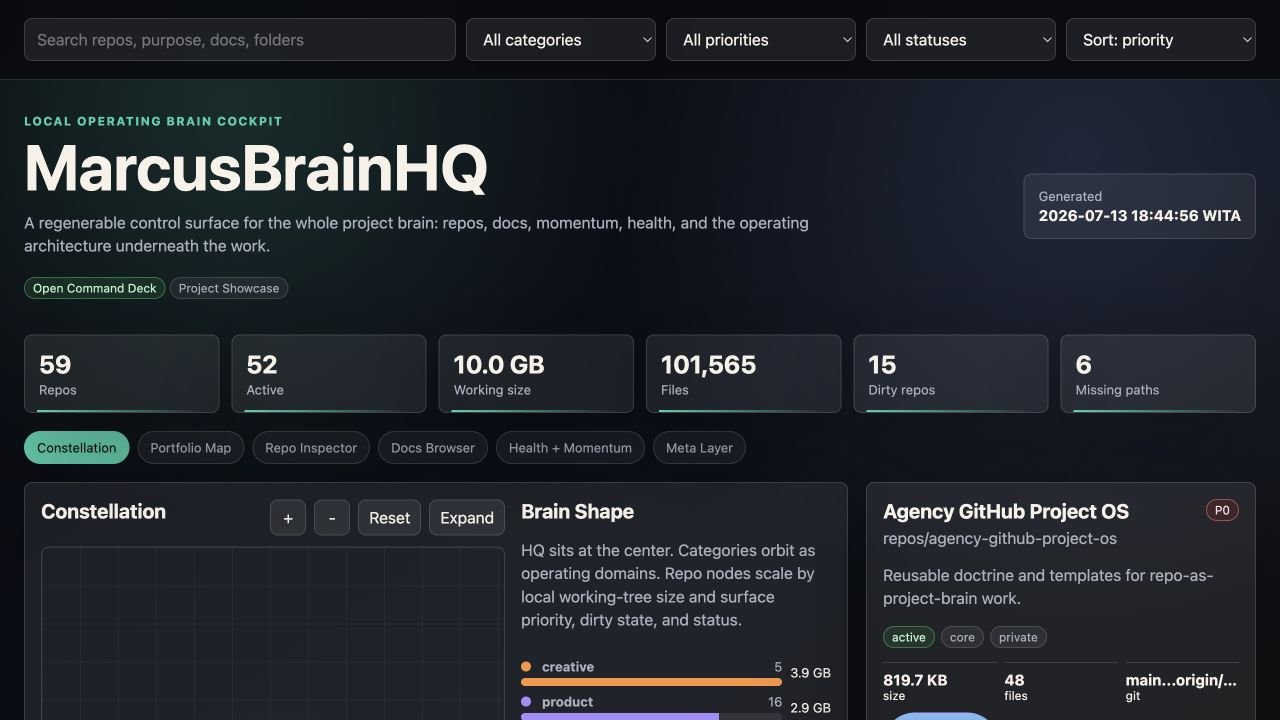
What matters, what changed, and what needs a decision across the work.
A sanitized studio cockpit makes priorities, readiness, and proof visible without exporting the underlying workspace.
Proprietary operating systems
We map how a company or creative practice actually runs, install a durable AI-native operating layer, and build the software that makes it useful every day.
What we install
Off-the-shelf software usually asks the organization to adapt itself to the product. We work in the opposite direction: observe the operating behavior, decide what should remain human, then build the smallest coherent layer that improves it.
The result can live across a repository, database, internal app, dashboard, agent workflow, document system, or public product. The architecture follows the work.
Systems proof
These are the components behind Symposium's delivery method. They are deliberately connected, but each has a distinct job and public boundary.
What matters, what changed, and what needs a decision across the work.
A sanitized studio cockpit makes priorities, readiness, and proof visible without exporting the underlying workspace.

Turn context into a scoped task, a run, a handoff, and a receipt.
A local workroom joins task context, agent runs, review, and shipping handoff around one bounded job.

Reveal missing evidence, weak handoffs, and the next useful forge action.
A readiness layer scans artifact families and turns visible gaps into a ranked next action.
Retain source lineage, privacy review, and retrievable project memory.
The current local ledger prototype makes source, event, artifact, privacy-review, and lineage contracts explicit before broad ingestion.
The installation model
Find the decisions, sources, handoffs, exceptions, and ownership that actually determine whether the work moves.
Install the smallest memory, workflow, agent, or software surface that changes a visible operating problem.
Document the rules, validate the behavior, preserve the handoff, and make the next improvement obvious.
Common forms
The software layer is chosen after the operating problem is understood. A dashboard may be right; sometimes the real answer is a governed archive, a release ledger, or one reliable handoff.
Projects, priorities, decisions, commitments, review rhythms, and agent instructions in one governed source of truth.
Intake, qualification, ownership, next action, follow-up cadence, exceptions, and owner visibility around existing demand.
Client work, proof, testing, issue routing, deployment checks, handoffs, and weekly delivery receipts.
Source archives, treatments, references, decisions, production stages, review gates, and release-ready artifacts.
Longer-range research
It asks what becomes possible when people own the encrypted context layer itself. That work is doctrine and research, not a product we are currently selling or a claim that broad life capture has been built.
Its role here is a design constraint: useful AI must be consented, bounded, inspectable, and owned by the person or organization it serves.
Build yours
The first useful system should be small enough to understand and important enough to change the work.