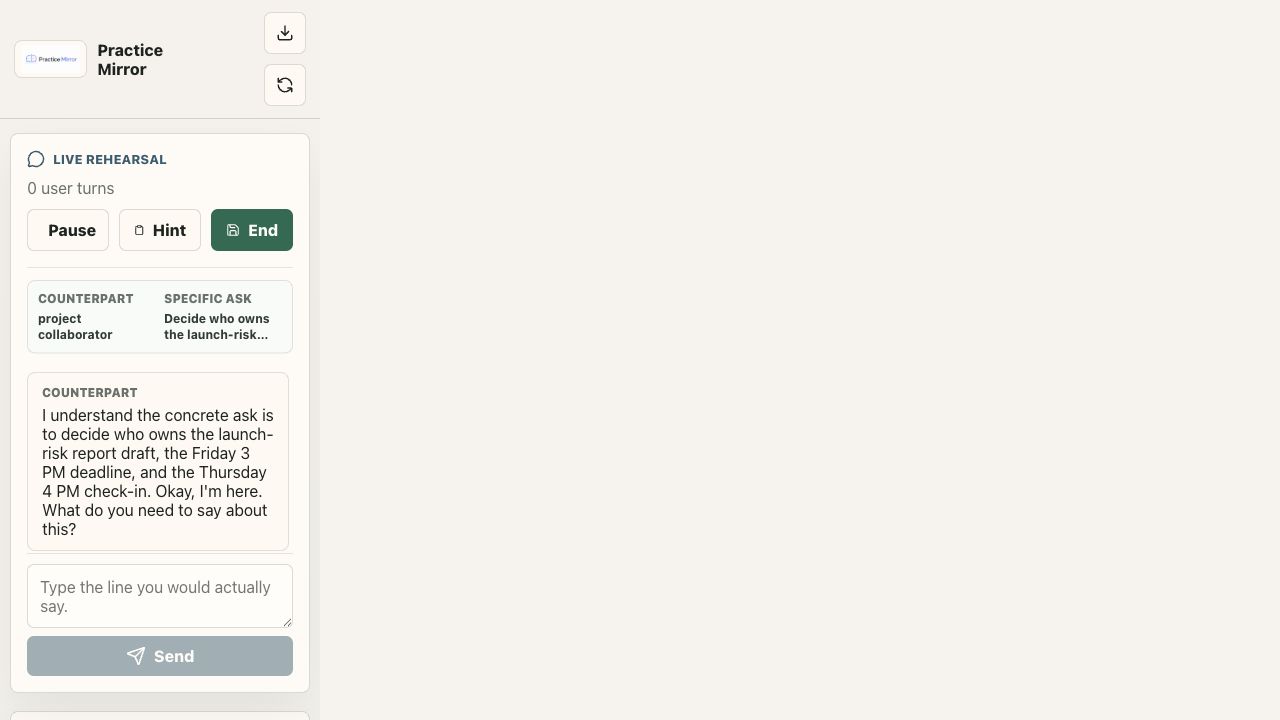
Working rehearsal
A role and a real ask frame the practice.
The rehearsal state makes the counterpart role and the user objective explicit, giving the conversation a bounded place to begin without simulating a real person.
Creative practice software / case study 06
Usable public demo
High-stakes conversations are often rehearsed alone, without a dependable way to set a role, practice a response, reflect on what happened, and return with more clarity.
The operating reality
What exists now
A guided rehearsal system makes roles, responses, coaching, and saved review explicit while keeping the real counterpart distinct from the practice environment.
Selected evidence
The interface structures practice without claiming to reproduce another person or decide the relationship.
Working rehearsal
The rehearsal state makes the counterpart role and the user objective explicit, giving the conversation a bounded place to begin without simulating a real person.
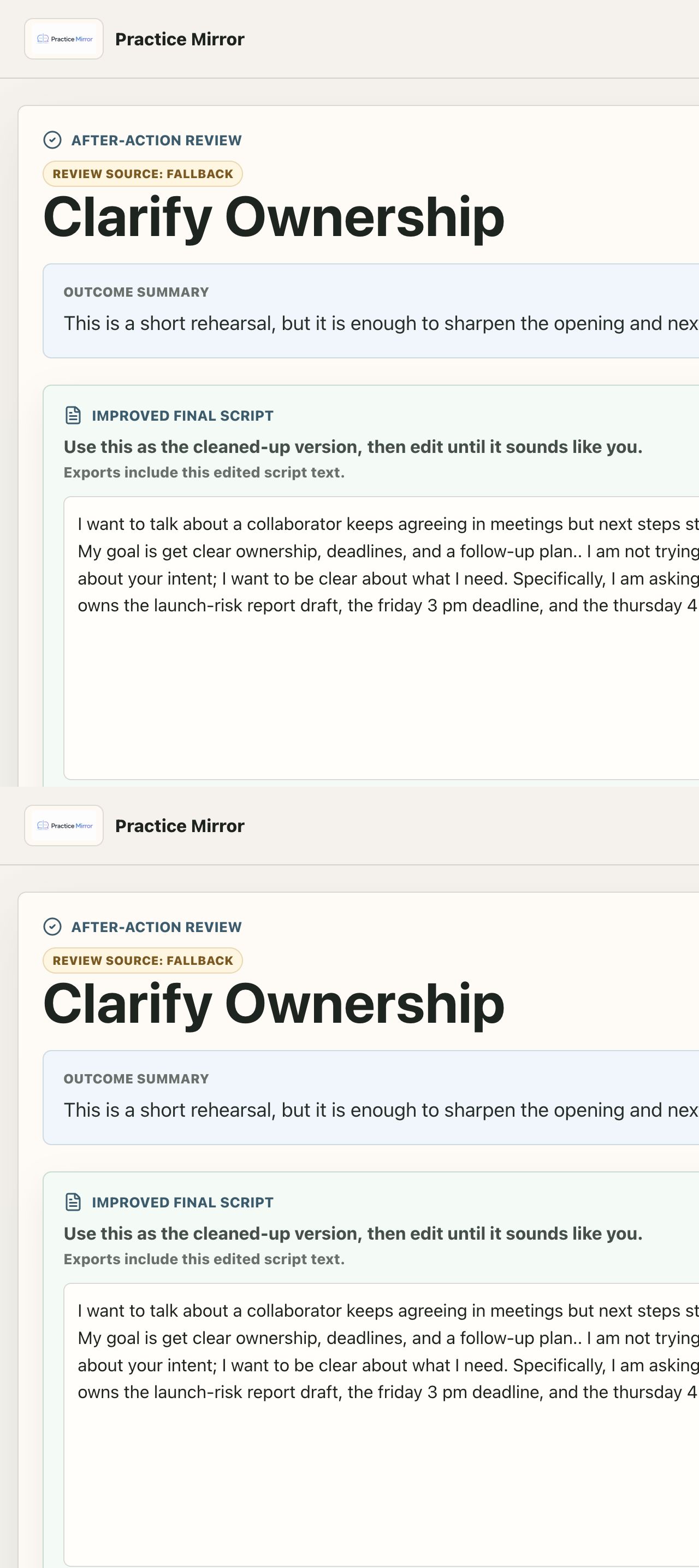
Returnable learning
The saved review focuses on a revised opening and next steps, so the product leaves the user with a usable practice artifact instead of an opaque AI verdict.
Working artifacts
Roles, coaching, and saved review remain explicit and revisitable.
The practice structure keeps the user’s perspective and the counterpart role legible.
Guidance supports reflection without replacing the decision-maker or inventing certainty.
A saved review makes it possible to return to learning rather than treating each attempt as disposable.
Public proof
Boundary
Practice Mirror is a rehearsal tool. It does not simulate another person, diagnose a relationship, or claim authority over the user’s real-world decision.
Relevant next step
Start with what the tool may help a person practice—and what must remain a human decision.